The Narconon Drug Rehab Program
The Narconon program is a unique combination of physical detoxification (to remove or reduce cravings) and life skills training. It is comprised of a series of distinct program steps which complement and expand upon the other. The end result is a person who is no longer craving drugs, is happy and has learned those life skills necessary to be successful in life.
- Drug Free Withdrawal
- Communication Section
- The New Life Detoxification Program
- Learning Improvement Section
- Communication & Perception
- Personal Values & Integrity
- Changing Conditions in Life
- Discharge and After Care Planning
The New Life Detoxification Program
How the Program Resolves Drug Cravings
While drugs and their metabolites quickly become undetectable in blood and urine, some as rapidly as 3 days after last usage, drug metabolites remain stored in fatty tissues for years. The accumulated drug residues which continue to cause drug cravings, a factor in relapse, led researchers to develop a program aimed at reducing levels of toxins in the body to assist in recovery.
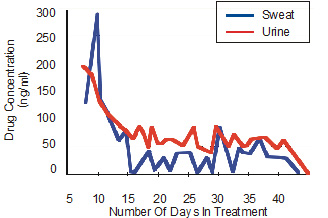
The graph depicts cocaine metabolites being excreted in the sweat and urine of clients participating in the Narconon® Detoxification Program. Levels of drug metabolites are not detectable in clients prior to the start of this program, then increase dramatically and slowly taper off as the program is continued. This supports the argument that drug residues remain in the fatty tissues and that the correct treatment can mobilize and remove them through the body’s excretory systems.
The New Life Detoxification Program utilizes a combination of exercise, induced sweating in a sauna, and nutritional supplements to produce the following results:
- Reduction or elimination of drug and alcohol cravings.
- Reduction or elimination of many symptoms associated with drug addiction and alcoholism.
- Ability to think more clearly. Increased Mental Ability (IQ)
- Improved memory and attention span.
- Increased energy.
- Increased sense of well-being.
- Enthusiasm toward Life.
Medical Evaluation- Clients will have a complete medical examination by the staff doctor (M.D.) which will include blood and lab work tests to insure that the client has or can still obtain optimum health for his body and mind.
Phase I
Drug Free Withdrawal/Orientation/Stabilization
Assist the individual to cease current drug use rapidly and with minimal discomfort through proper nutrition, vitamins, and care from experienced Staff.
Staff provides 24 hour a day care during this period until the client is stable.
Communications Section
This section extroverts the student and gets him into better communication with others and his environment.
An addict can be quite deficient in his ability to communicate and confront others as witnessed in most by their tendency to withdraw from life.
This area will need a lot of work and is further addressed later in the program. The first section is an elementary introduction back into life and is vital for success with the next phase.
The New Life Detoxification Program
An exact regimen of exercise, dry-heat sauna, and nutritional supplements that rid the fatty tissues in the body of drug residues and other accumulated toxins. The end result finds the client with increased mental acuity, higher energy levels, greater cognitive and awareness levels, an increased sense of general well-being, and the elimination of the bio-physical drug craving.
The Learning Improvement Section
Drug abuse studies show a distinct correlation between poor school performance and drug use. This section gives the client the ability to study and retain knowledge by recognizing and overcoming the barriers to study and learning. Learning is a vital tool to be used throughout the remainder of life..
The Ups & Downs in Life Section
Teaches the necessary knowledge to achieve greater personal stability and happiness in life. The client learns to find real friends, relations, and associates that will help him throughout his life. Plus he learns to identify those that will bring him down or are only interested in him for something from which they can prosper. It is an observable fact the drug addict usually has a circle of friends that are actually a liability to him, here he will learn to make good solid relationships.
The Way To Happiness Section
Teaches the client a secular moral code as a guide to living a happy life, a good common sense guide to build a firm foundation for living, bringing up the clients own morals and values with it.
Eligibility For Admission
The purpose of the Narconon Drug Rehab is to help people get off drugs. People with extensive psychiatric histories or who have been on long-term psychiatric medication may therefore be inappropriate for admission. Your intake counselor can help you determine whether Narconon can help.
Program Fees
Please check with your intake counselor regarding financial arrangements.
Phase II
The Communication & Perception Section
A form of cognitive therapy that is applied through specific exercises and drills. The end result is an individual who no longer automatically reacts to situations. Instead, he now thinks out rationally and logically what to do to enhance his own survival. This section is the advanced part of the original communications section started earlier in the program. The client helps another do the exercises. By taking responsibility for helping another, the client increases his own responsibility levels and gains the ability to handle life.
The Personal Values & Integrity Section
We have all heard the old adage " Confession is good for the soul" the 12 step programs uses it as step four "personal moral inventory". Narconon finds it vital for an individual to rid himself of the shame, guilt, baggage, chips on the shoulders, etc. The only way our clients do that completely is through taking responsibility. This section works by raising the client’s responsibility level and then gives him the knowledge necessary to determine one’s own values and achieve high personal integrity and honesty.
The Changing Conditions in Life Section
After one learns to assume responsibility for their life and their behaviors in the above section it will be necessary to repair certain areas of destruction that came about due to their drug use. This section teaches the exact steps that improve current conditions in life and repair previous bad conditions. Some of that repair may need to be done after discharge and that is why this section will often blend with the next.
Discharge and After care planning Section
This final section serves as support for the client. After completing the residential stage of treatment, they will then be ready for the transition back into society. An aftercare program will be uniquely tailored to the individual and will encompass several areas: Support systems, Lifestyle changes, Educational planning, Financial planning, self-enhancement goals, Relationships, Living arrangements, and Social / Spiritual development. It is not uncommon for the family of the client to be involved in this section and might actually be an active participant in the aftercare plan. Each client varies so there are no set requirements for the family involvement.
The drug rehab program is complete when the student recognizes and accepts responsibility for old habit patterns and harmful actions against others. The student examines and rehabilitates relationships with self, family, friends and society. The student creates a life plan for growth in all areas of life.
Students leave Narconon Drug Rehab enthused and ready to embark on their new life.
Staff Commitment
The Staff at Narconon Georgia are certified in the administration and procedures of the Narconon drug and alcohol rehabilitation technology. Our professional, experienced and caring staff is dedicated to saving people's lives which have been destroyed by the effects of drug and alcohol abuse.